Mankell Family History
District 25 School and Lake Andrew Township
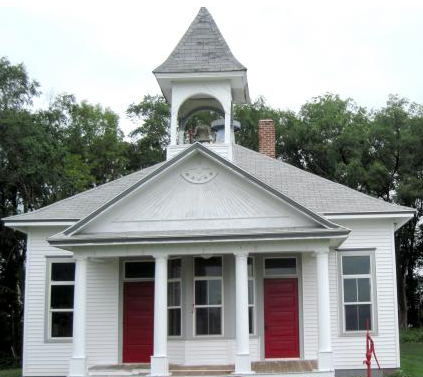
Former Lake Andrew Townhall and District 25 School Building,
Corner of County Highway 5 and 165th St NW (July 2012 to present)
District 25 School
County School District 25 began in 1868. Several area farmers and settlers (HW Mankell, Ole Dahl, Amund Syverson, Erik Erikson, Lars Hedin and Iver Gulvson) petitioned the County Commissioners of Monongalia (later the northern half of Kandiyohi County) for an organized school district. The 1905 Illustrated History of Kandiyohi County states:
The undersigned, a majority of the legal voters of the territory to be affected thereby, do hereby petition your honorable body to organize a new school district to be comprised of the following described territory, to wit: In the town of Norway Lake, sections 19, 20, 21, 28, 29, 30, 31, 32, 33, in township 121, range, 35, or the southwest quarter of the above named township containing nine (9) square miles. Dated at Norway Lake this 26th day of February, 1868. (note: At the time, this area was in Norway Lake Township. Lake Andrew Township was created in 1872)The petition was granted and the notice to organize was sent to HW Mankell on May 2, 1868. A year later the district grew to include a portion of section 22 and all of sections 27 and 34. In 1876 section 26 was added; in 1881, part of section 17 was added.
For the first months, 17 school children met at the Mankell homestead, in a dug out west of the farmhouse. This location was temporary until a wooden building was completed. In 1869 the school was moved to its first wooden structure--a log building located about 3/4 miles south of the Mankell homestead. The district used this 16x20 feet log building for 12 years. Its location was about 1/2 mile west of what is now the intersection of County Roads 29 and 5. In about 1881 the school moved to a small frame building newly erected on the northeast corner of the Highway 5 and Highway 29 intersection, on the John Nelson farm. Here are the 1900 boundaries of District 25, delineated in the 1900 Plat Map of Lake Andrew Township. In 1912 the school moved again to its final school building (which exists today at a new location one mile north), located at the SE corner of the 29/5 intersection. Local elementary-aged children attended this school until the New London-Spicer School District absorbed the area country schools in the early 1960s. (Older youth were already attending high school in New London and Spicer.)
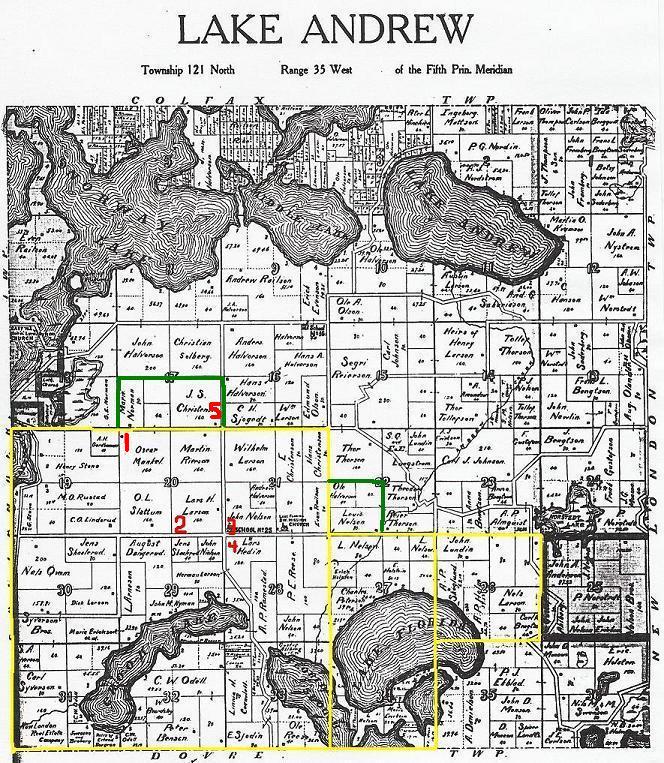
1905 plat map of Lake Andrew Township.
Yellow lines mark the early borders of the school district:
the first 9 square miles, with 3 more square miles added later.
Green lines mark portions of Sections 17 and 22 in the district (approximate)
The borders changed overtime, especially the western edge when School District 104 began.
Red numbers indicate the locations of the school.
- Mankell Homestead, 1868
- First Log Building (location is approximate), 1869-1881
- Location on Highway 5, (north of Highway 29), 1881-1912
- Location on Highway 5, (south of Highway 29), 1912 - July 2012
- Location on Peterson farm, July 2012 - present
Location 1, 1868 and Location 2, 1869-1881:
The following excerpts are from a letter HW Mankell wrote in December 1868 to his sisters Augusta and Hermina who lived in Sweden. He discusses the education of his children and the beginning of District 25.
Hermine, I really don't know when you will receive a letter from Jenny, and when it does come, it will probably be written in English. The children have had only three months schooling during the last two years, so you can surely understand their limited learning.(The website has additional quotations from this 1868 letter, about HW's children and about the financial situation on the homestead.)
With much trouble and inconvenience on my part, I was able to start a District School here last summer. It lasted three months. I had dug a cellar to be used as a shop for doing carpentry, which I seldom find time for. Thus we fixed it up for a schoolroom. There were seventeen children. The English school teacher was an eighteen-year-old girl. She lived with us during the time and was a companion and of great help to Betty. We will have school next summer, perhaps in the same place, as there is very little prospect of getting a schoolhouse built before then.
The following article "Glimpses of Pioneer Life" was written by Gabriel Stene for the July 10, 1927 issue of the Willmar Weekly Tribune. At the age of 12, Gabriel was one of the first children to attend the new District 25 school:
School District No. 25 of Kandiyohi County, originally Monongalia County, was one of the old pioneer landmarks. It was organized in the spring of 1868. At that time this country was a wilderness. There was not a single road laid out in a section line. The roads ran curving and winding about wherever it was found expedient, partly along buffalo and Indian trails. There was no school or schoolhouse but a large bunch of children of school age.
About four rods west of Mankell's residence may be located the spot which shows the place where Pioneer Mankell had a dugout in the hillside--clay floor, clay walls, rails, hay and sod for roof. There was a door to the east and a little window by the door. This dugout was used for a carpenter shop, and here Mr. Mankell had his tools stored away. He was a carpenter by trade. He volunteered to move out and surrender his dugout for school purposes. Miss Rose Burdick opened the first term of school in District No. 25, in said dugout and it continued there until the log schoolhouse, 16 x 20 feet, then under construction three-quarters of a mile west of where the present schoolhouse now stands--could be completed. Logs for this building were donated free by owners of timber and work was done free of charge by citizens of the district. Take a look at the present modern schoolhouses and note the contrast.
One day when standing up in the spelling class and having been given a word to spell, I was overtaken with feelings which I could not understand--a fainting spell. I grabbed hold of Carl Syverson by one hand and Mary Mankell by the other, but went headfirst to the floor. Pioneer Mankell was called and responded. When I had recuperated (they had me out on the ground and applied cold water to my head) Mr. Mankell, who was a man of sound judgment, said: "This hovel is not fit for school purposes. It is too close. We must either stop school or secure better quarters." We were then transferred to the log cabin of Amund Syverson, where he lived with his family. Here we were accommodated and made the best of the situation as we could.
Finally the little log schoolhouse was completed--rude log walls, home-made door, home-made desks and table made by Pioneer Mankell and unplaned rough boards for the floor.
One fine Monday morning the key was turned over to Miss Burdick, who dedicated the building by the initiation of an enrollment of 42 pupils. These were the happiest bunch of school children west of Minnehaha Falls--Minneapolis was not heard of in those days. The first week slipped by. It was hard to study in a schoolbook, with two or three pupils hanging over one book! The teacher had made out an order for necessary supplies which was approved by the board. This was on Friday night. The question arose, "Where is the supply to be found and how to get them?" The teacher said: "They are to be found a Sam Adams' Store at New London." But everybody was using ox-motors in those days. I was only 12 years old but volunteered to travel on foot and get them. I started off bright and early Saturday morning. At New London I found only six slates and some slate pencils. Scratch books and pencils were not in use then as now. Every child had to be supplied with a slate and slate pencil.
Next morning being Sunday three young men at the age of about twenty years, Axel F. Nordin, Simon Syverson and Gunder Swenson, met at the schoolhouse for the purpose of organizing a Sunday School. The school supply question then came up and I gave my report. I told them that Sam Adams had said that such supplies could not be had nearer than St. Cloud or possibly Paynesville. I said that I had promised to get them and would redeem my promise if I had to go to Paynesville.
Peter Nordin, a homesteader on the now Carl Danielson place, spoke up and said: "I just returned from the new Foot Lake station last night. I saw school books at the store there. Feel sure that they may be had there." "Where is Foot Lake Station?" "South of Foot Lake on the new railroad being built out from St. Paul." I asked "Where is the road leading to it?" He said: "There is no road direct. No bridge across Shakopee Creek south of Crook Lake. But there are two ways of getting there. One is by Nest Lake, Eagle Lake and south. The other is west to the soldiers' patrol road, crossing the creek at Gunder Pederson's place on the Government log bridge."
At four o'clock Monday morning I made for the soldiers' patrol road westward in Arctander. This I followed to Lake Mamre, where that road ran east towards Eagle Lake. There I had to take a faint trail running south towards the new track going west of Solomon Lake and east of what is now Pennock, then east five or six miles to the railroad builders' camp.
Had a great time crossing the outlet stream near where the cemeteries are now located. There was no bridge. The trail led me to this grove where our Memorial Pioneer log cabin is now located, then through a wheat filed in what is now First Ward of Willmar. I found a little store north of the track. South of the track there was nothing but mules, horses, ploys, scrapers, and busy railroad builders.
What I was looking for I succeeded in finding at the little store. I had two dry slices of bread in my pocket which I devoured with the aid of water from a pail, my first lunch in the now city of Willmar. Then shouldering my luggage, I started back...I struck the patrol road where Solomon Lake church now stands. Here I met a homesteader who said that a bridge was just completed across Shakopee Creek near Crook Lake grove... He took me to the top of the Dovre hills where I saw the whole Norway Lake panorama...
I had walked from 4:00 in the morning till midnight and had covered 40 miles to get those supplies for the new School District 25. This is my old home school district where I spent my pioneering childhood and boyhood days, where I first learned to read, write and spell.
The following is the first enrollment of District No. 25:
1868-1869:
- Axel F. Nordin, 20 years
- Theodore Bjornstad, 6
- Ben Iverson, 13
- Peter Iverson, 7
- Lena Iverson, 11
- Axel Erickson, 10
- Johanna Erickson, 7
- Adrian Hemming, 8
- Leonard Hemming, 6
- Erick Hedin, 6
- Johanna Hedin, 20
- Emma Hedin, 9
- Josephine Hedin, 6
- Otto Hedin, 6
- Arnt Reese, 8
- Julia Syverson, 11
- Martin Syverson, 10
- Inger Syverson, 9
- Gabriel Stene, 13
- Ole Stene, 11
- Frederick Stene, 9
- Henry Stene, 7
- Inger Maria, 5
- Carl E. Warholm, 15
- Lars Nelson, 16
- Ingebor Nelson (Mrs. J.A. Halvorson) 4
- Christian Olson, 8
- Beatha Olson, 11
- Olai Christofferson, 6
- August Christofferson, 6
- Karin Christofferson, 10 (Mrs. N.N. Abrahamson)
- Sophia Brattlund, 15
- Caroline Brattlund, 18
- Johanna Brattlund, 10
- Jennie Mankell, 11
- Mary Mankell, 9
- Anna Johanna Mankell, 7
- Amanda Mankell, 5
- Johanna Hedin, 20
- Emma Hedin, 9
- Josephine Hedin, 6
- Otto Hedin, 6
Location 3, 1881-1912:
The location and boundaries of District 25, delineated in the 1900 Plat Map of Lake Andrew Township.
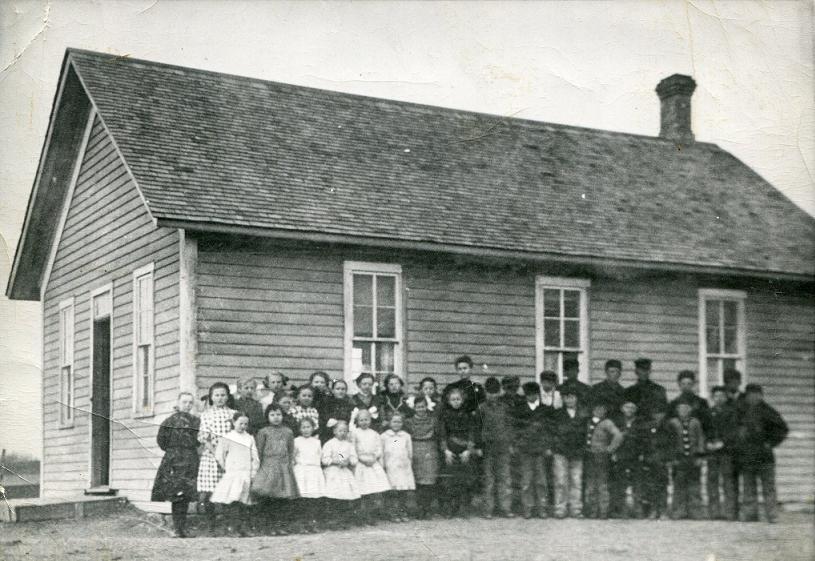
Building and students, c1900.
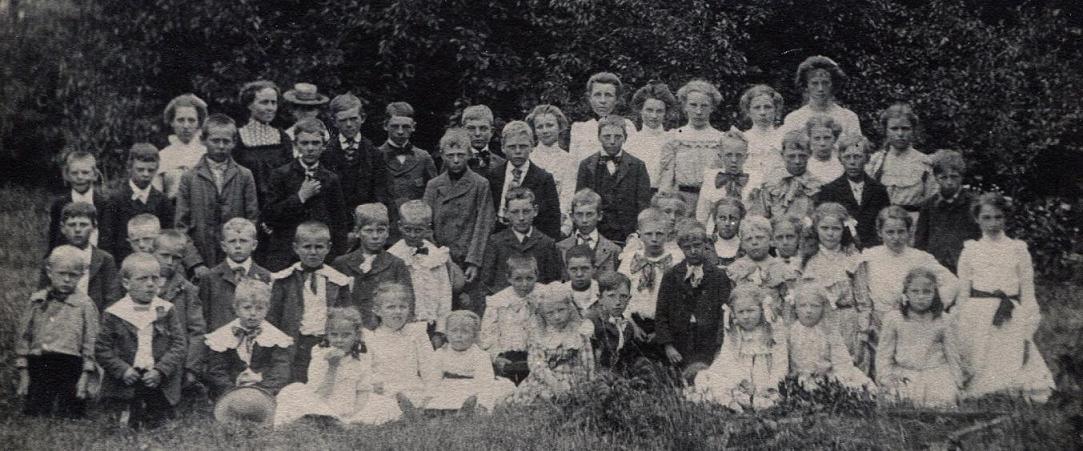
Children of School Districts 25 and 16 joined together for a picnic, 1902
at the Hans Halvorson farm (later the farm of Alvin and Edna Halvorson).
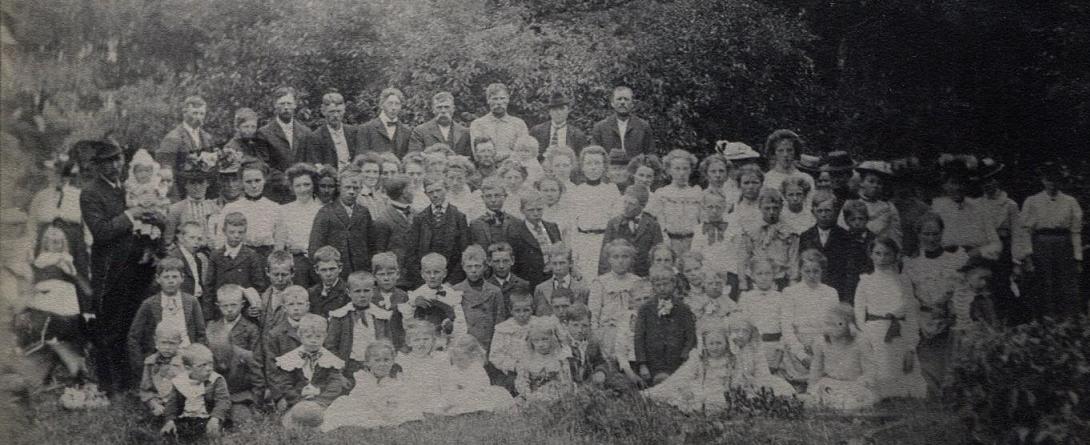
Children and parents of School Districts 25 and 16 joined together for a picnic, 1902
at the Hans Halvorson farm (later the farm of Alvin and Edna Halvorson).
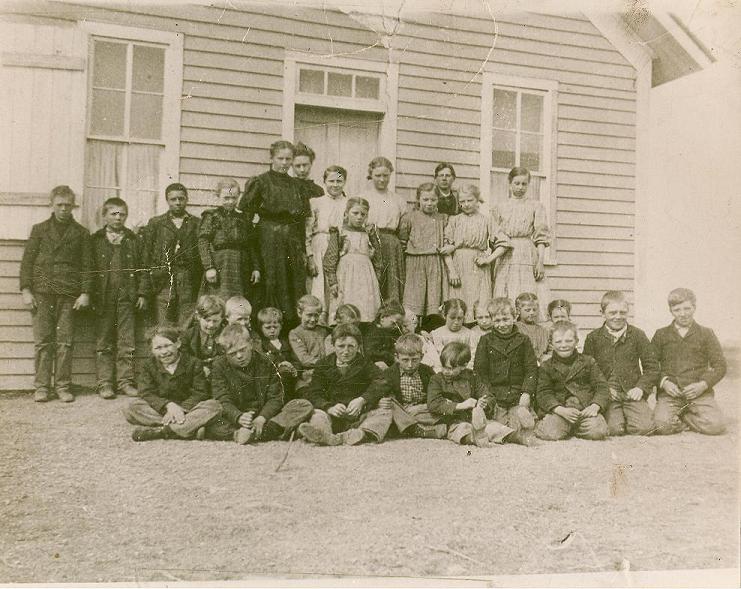
Class, c1908. School children at District 25, located north of highway 29, (Location #3).
Herman Mankell is in the front row, last child on the right. Edna Mankell is in the second row, second from the right. Alice Mankell is in the second row, sixth from the left.
Classmates in above photo, c1908:
Standing, l-r: Olaf Linnerud?, name?, name?, name?, Amundson?, Linnerud?, Lillie Larson?, Agnes Larson, name?, Larson?, name?, Hattie Larson, Grace Larson?
Seated, back row, l-r: name? name?, Ben Rustad, Clara Christenson, name?, Alice Mankell, name?, Agda Nelson, Mabel Railson, Edna Mankell, Edith Larson
Seated, front row, left to right: name?, Edwin Railson, Leonard Bengtson, name?, name? name?, Skaalerud?, Bill Railson, Herman Mankell
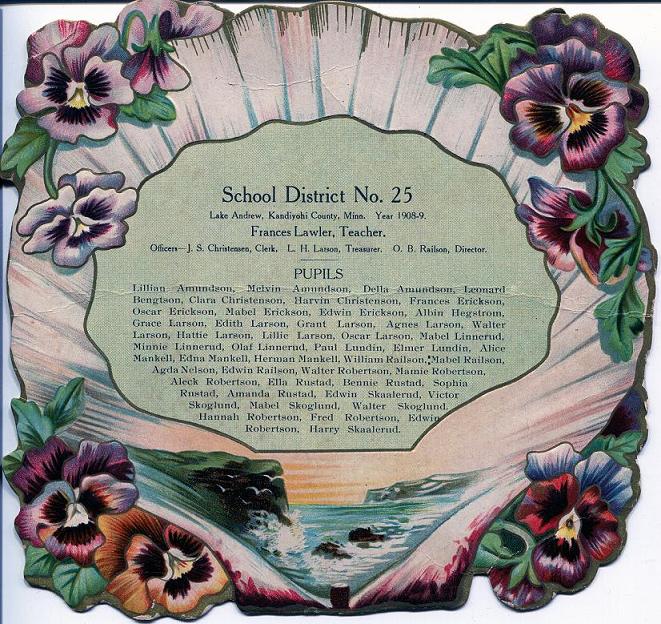
Students and administration, 1908-1909.
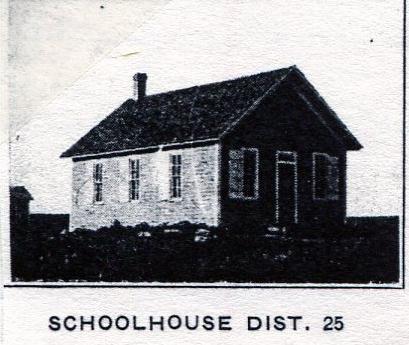
School building with window shutters, c1910.
Location 4, 1912-2012:
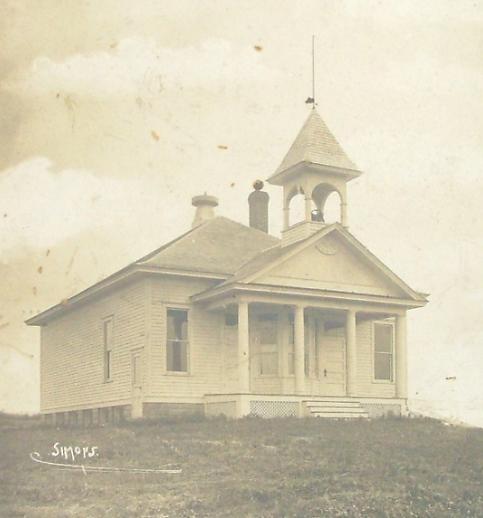
New school building, c1912.
Note the entrance on the north side of the building.
Man is a social being. He has his highest development in a free and friendly, social and ____ course where intelligence and justice prevail and determine every act. To develop and maintain these social qualities in the highest degree schools are established and churches are instituted.
The people of District 25, mindful of their duty and responsibility to the coming generations, has caused this beautiful place of learning to be erected and which we dedicate today.
To the boys and girls of this school district, these precious buds of humanity that shall bloom into manhood and womanhood to adorn their country, we dedicate this building.
To the ambitious youth and the aspiring maiden who are seeking the avenues to a useful and noble life, we dedicate this building.
To truth, justice and good will among the people, we dedicate this building.
And lastly to the service of the people, of our country and our God, we dedicate this building.
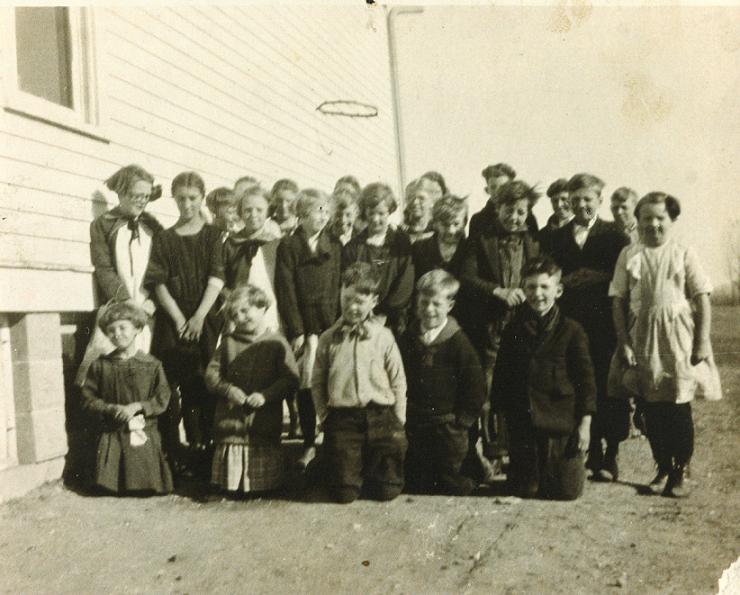
Class in 1923.
Classmates in above photo, 1923:
Standing, back row, l-r: name?, Elsie Larson (face hidden), Birdie Dengerud?, Reynold Larson, name? (face hidden), Helen Bierman, Gladys Dengerud (face hidden), Reynold Nelson, Walter Dengerud, Elmer Larson.
Standing, front row, l-r: Eunice Reese, Arlette Thorson, Harriet Reese, Martha Okland, Eleanor Swenson, Harold Newman, Sigvold Stockland, name?, Evelyn Newman
Kneeling, left to right: Gunhild Stockland?, Esther Okland, Merton Reese, Stanley Okland, Orville Thorson
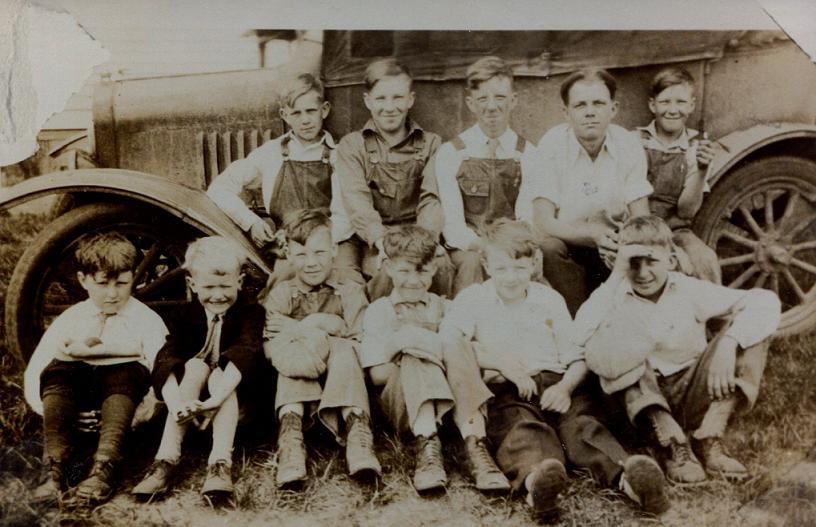
Boys in front of Gerhard Swenson's Model T Ford at District 25, 1932.
Back row, left to right: Isaacson, Oliver Swenson, George Swenson, Isaacson, Leroy Swenson
Front row: Donald Swenson, Malquist, Malcolm Swenson, Duane Swenson, Manfred Newman, Fritchof Aasen
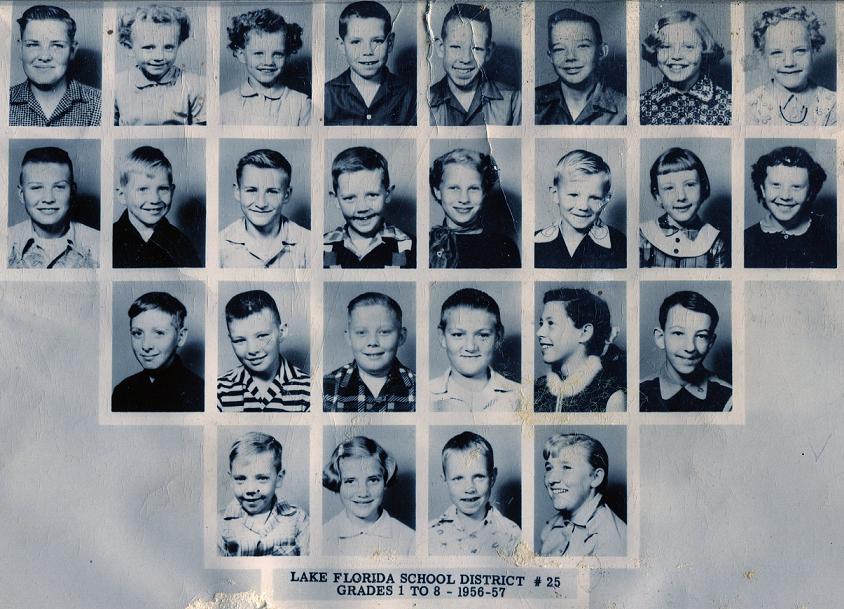
Students at District 25, 1956-1957 school year.
Top row: Roger Danielson, Knutson, Knutson, Steve Nelson, Perry Nelson,
Jean Geer, Tom Knutson, Valerie Johnson
Third row from top: Joel Haglund, Glen Dengerud, John Tjernagel, Eldon Skoglund,
Paulette Nelson, Conrad Johnson
Bottom row: Loren Hjelle, Marlys Mankell, Richard Peterson, Gail Dengerud

Class in 1958; Mrs. Gustrud, teacher.
- First row (Front to back): Teddy Dengerud, Janet Nelson, ?, ?
- Second row: Bertil Haglund?, Richard Peterson, Steve Nelson, Dale Hjelle, Jimmy Denegrud
- Third row: Johnson, ?, Loren Hjelle, Marlys Mankell, Nancy Peterson
- Fourth row: Joel Haglund, Eldon Skoglund, ?
- Fifth row : Perry Nelson, Conrad Johnson, Paulette Nelson, Kendall Railson.
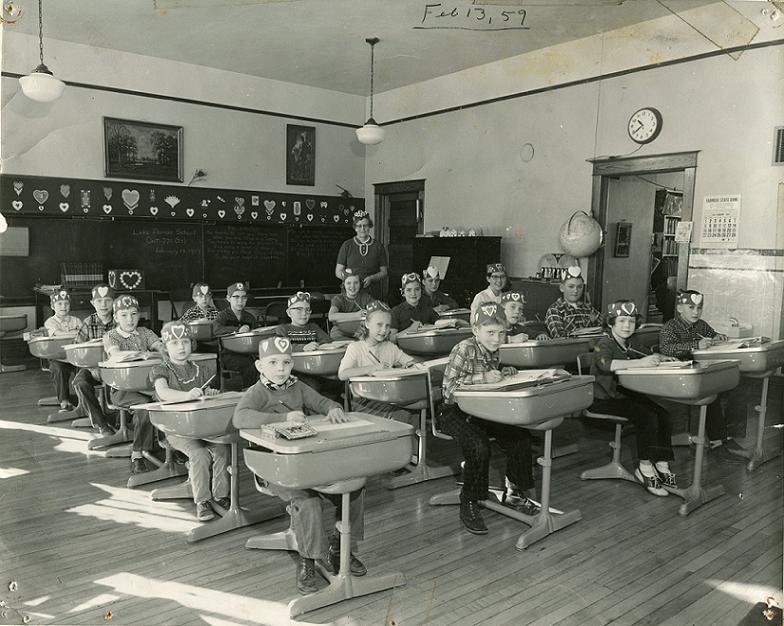
Class in 1959; Mrs. Gustrud, teacher.
Marlys Mankell Schilz wrote about "The Last Day of School" for District 25 which was in the spring of 1963. Below is a portion of Marlys' essay.
It was the last day of school, not just the end of the school year but the end of the school. It was called consolidation. The following school year, our small, country district was joining with the town school. My mother didn't like this progressive plan. She was proud of our small school and its products. She knew it was the end of an era.
Recently, I read about a "new" learning method where there was a mix of older and younger kids in the same class at different levels. The kids met in small groups with the older ones helping the younger kids. It did not sound new to me.
I have been thinking about that final day. I walked home alone. At least I thought I was alone. Every few feet i would turn around and walk backwards, my lunchbox bouncing on my knees. I looked at the school as if taking a final picture. I was glad to be leaving or so I thought. Finally, one time I looked and in one fragile moment, it was gone. In just one step I went from reality to the unknown. My mind was playing a movie of bits and pieces of all the years. I remember the time that an angry first-grader took off walking home cross-country. My brother in eighth grade was sent to retrieve him. I can still see my friend running across the ball field, her index finger shaped like a letter L pointed in the wrong direction. Then there were days of hot lunch where our teacher would bring a roaster. We each had brought a potato with our initials carved on the skin, along with butter and salt. I have never tasted a potato that good. Also, I recall the excitement of Christmas programs on the make-shift stage.
What do potatoes, softballs, and Christmas programs have in common? "These are the things that bounded me" said Edna St. Vincent Millay.
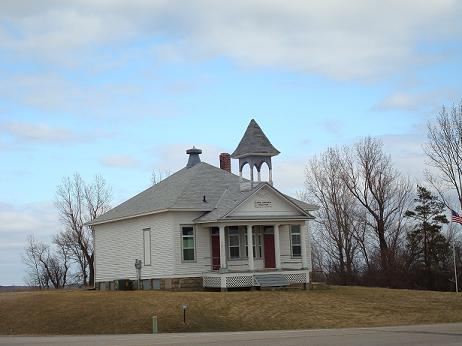
Former Lake Andrew Townhall and District 25 building,
corner of County Highway 5 and County Highway 29, 1912-2012.
Teachers:
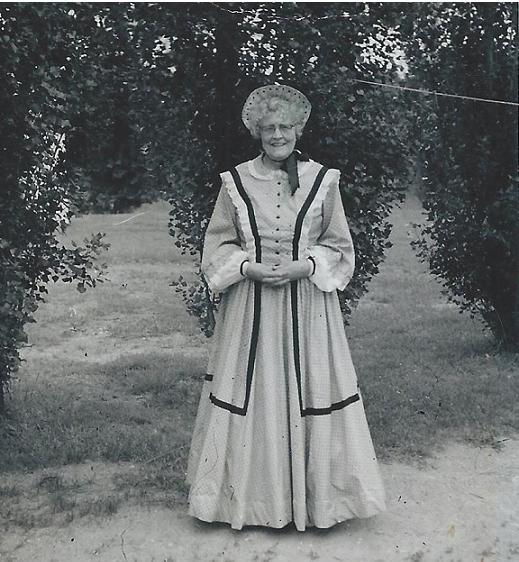
Mrs. Gustrud in costume, celebrating Minnesota's 100th birthday in 1958.
More than 70 teachers have guided the children and youth of District 25. Here is a roster of all the teachers, with their approximate years of service (S=Spring; F=Fall). Thanks to Orlynn Mankell for compiling this list.
- Elenore Cartis, 1868, Summer
- Sophia Bratlund, 1869-1870
- Rose Burdick, 1868-1872
- John Matson, 1873
- Olaf Aschim, 1874
- Sophia Swanson, 1875
- Anna Egge, 1876
- Maria Railson, 1877
- C.A. Syverson, 1878
- Thorwald Nilson, 1879
- Jennie Henderson, 1880
- Jane Johnson, 1881
- Jessy Henderson, 1882
- John Patterson, 1883
- Bergitta Bratberg, 1884
- Anna Hanson, 1885
- A.O. Morwatt, 1886
- Susan Berndon, 1887
- John Quam, 1888
- Otto Monson, 1889
- Elias Mostue, 1890F
- Lilliam Moor, 1891F
- J.S. Christenson, 1892S
- J.W. Johnson, 1892F
- Charles A. Nelson, 1894F
- Nora Odell, 1895
- Julia Halvorson, 1896
- Mathilda Slattum, 1898-1899
- J.S. Christenson, 1899
- Emma Peterson, 1900
- Theodora Ellefson, 1901
- Anna McManus, 1902S
- Lina Slattum, 1902F, 1903, 1904F
- Ellen Shipstead, 1904S
- Nora Odell, 1905S
- Ida Lorentzen, 1905F
- Etta Davenport
- Frances Lawler
- Clara Everson
- Regina Farmen
- Amanda Johnson
- Emanual Franklin
- Johanna Mittvet, 1913-1914
- Horace Reese
- Ellyn Anderson
- Alphia Olson,1917-1920
- Alma Bratberg, 1921-1922
- Anna M. Johnson, 1922-1923
- Alice Kruger, 1923-1924
- Myrtle Heimdahl, 1924-1928
- Eunice Peterson, 1928-1930
- Esther Njus, 1931
- Margaret Olander, 1931-1932
- Elvera Skavdahl, 1933-1934
- Viola Newstrom, 1934-1936
- Harriet Reese, 1936-1937
- Mrs. Frances Klein, 1937-1938
- Florence Jenro, 1938-1939
- Mrs. R. Shelman, 1939-1940
- Lillie Jensen, 1940-1941
- Ida Amundson, 1941-1943
- Roda Railson, 1944-1945
- Manda Swenson, 1944-1945
- Ella Holmgren
- Delores Thompson
- Luella Fredrick
- Arlene Nygard
- Mrs. A.C. Gustrud, 1951-1960
- Mrs. Richardson
- Mrs. Donald Birkland
Boundaries of area school districts before consolidation with the New London School district in the early 1960s. (Also a PDF file of all rural school districts in Kandiyohi County)
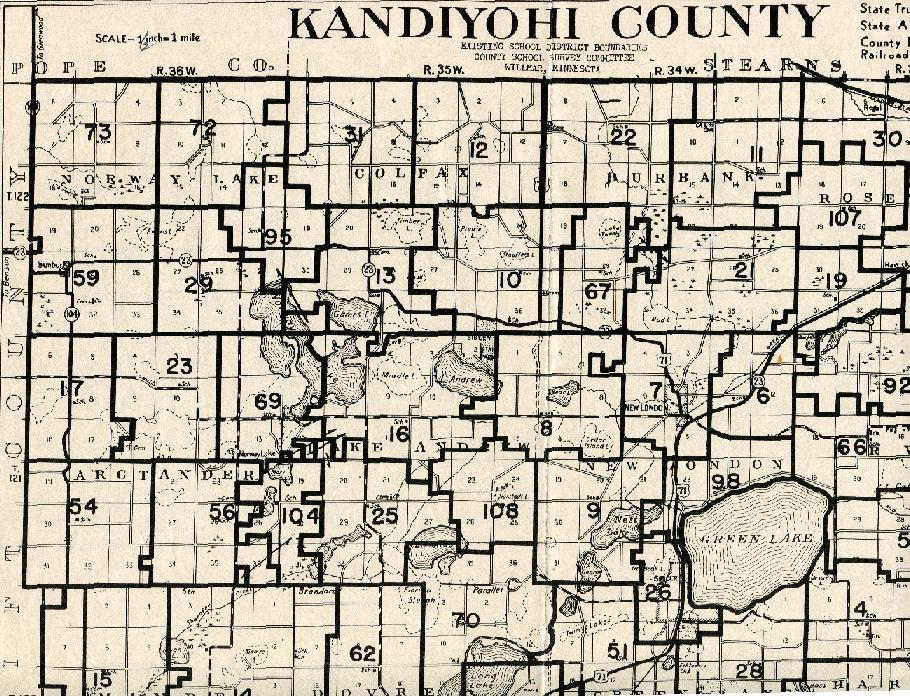
This undated diagram shows the boundaries of area school districts, including 25, 104, 56, 69, 16 and 108.
Location 5, 2012-present:
The old Lake Andrew Townhall and former District 25 school was moved on July 17, 2012
On July 17, 2012, the former Lake Andrew Town Hall building (District 25) was moved 1 mile north on Highway 5 to the Earl and Eldora Peterson farm. Because the township decided to replace the historic building with a new facility, Lorna Peterson purchased the older building and moved it to her family farm. It was one of the final wishes of Eldora Peterson, before her death, to know that the school building was saved from destruction.
Here is a link to an August 2013 article and video by Carolyn Lange Hatlestad for the West Central Tribune about the renovation.
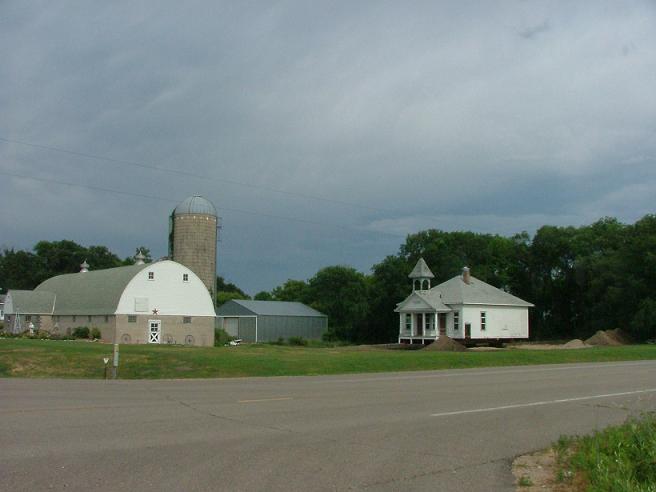
At the Peterson farm, July 2012
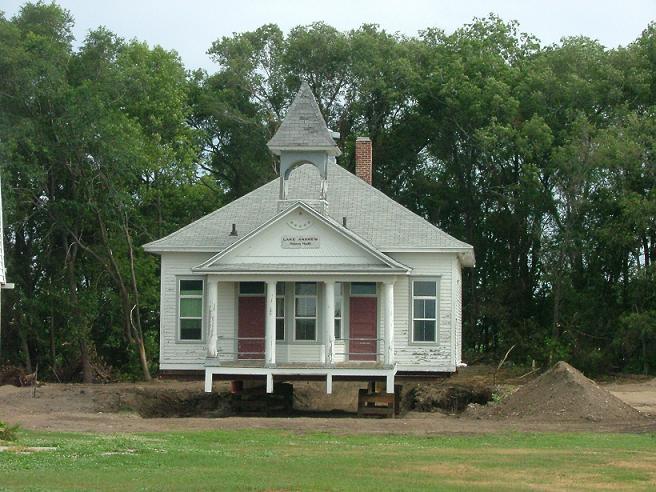
District 25 School at its new home, July 2012
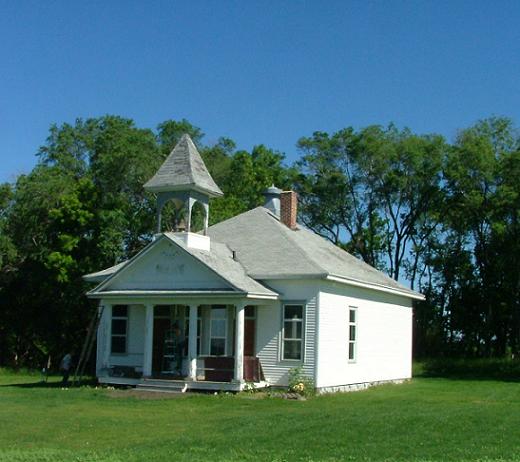
Former Lake Andrew Townhall and District 25 School Building, June 2013.
Corner of County Highway 5 and 165th St NW.
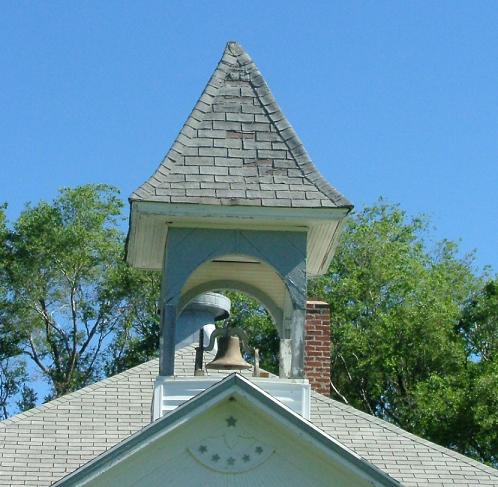
New bell sits atop the building, June 2013.
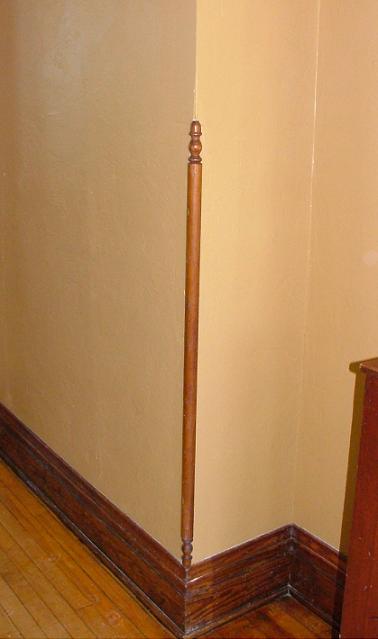
Detail of trim in the library, June 2013.
District 25, August 2013
Township of Lake Andrew
The Lake Andrew Township was created in 1872 out of the larger Norway Lake Township, following a petition signed by 51 residents of township 121, range 35, which was presented to the County board. These petitioners asked that they be granted a new township government. This change was due to the work of HW Mankell who organized the petition drive. The first township meeting was held on March 19, 1872 and the name given was 'Lake Andrew". HW Mankell was the first assessor for the township; at later dates he was Chairman, a Justice and a Constable. His son, Otto Mankell served as a Township Supervisor and a Constable. Later, his grandson, Herman Mankell would be on the township board for more than 25 years. These men served with their neighbors in these various township positions. Without the dedicated work of these pioneers, the township would not have been formed or survived. The township board meets in the old District 25 school house. (#4 on above map.)
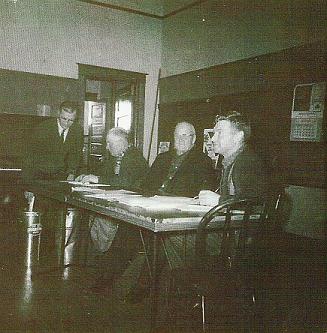
Lake Andrew Township Board, 1969: Herman Mankell, Otis Thorson, Otis Halvorson, Ellsworth Hatlestad